Back to Case Studies
O'Stin Mass-market apparel brand

O'Stin — How does a mass-market brand earn attention from people who scroll past discounts?

Creative & communication strategy for a national image-led campaign by a mass-market apparel brand.

BRAND
O'Stin
TYPE
Creative & comms strategy
YEAR
2023/2024
CATEGORY
Mass-market apparel
FORMAT
National TV & digital
AGENCY
Leo Burnett
Challenge

The discount was the budget for the work, not its message.

O'Stin is a mass-market apparel brand serving two distinct audiences: traditionalists, and a younger, more fashion-attentive group the brand internally calls young stylish ladies. For the summer season the brand launched a collection of pink dresses, with a promo mechanic of −20% in the mobile app over a defined two-week window. The brief asked for a national TV and digital campaign to support it.

On the surface this was a straightforward retail-promo task. The obvious execution writes itself — show the product, name the discount, drive the app. Every mass-market apparel brand does exactly that — and that was the trap.

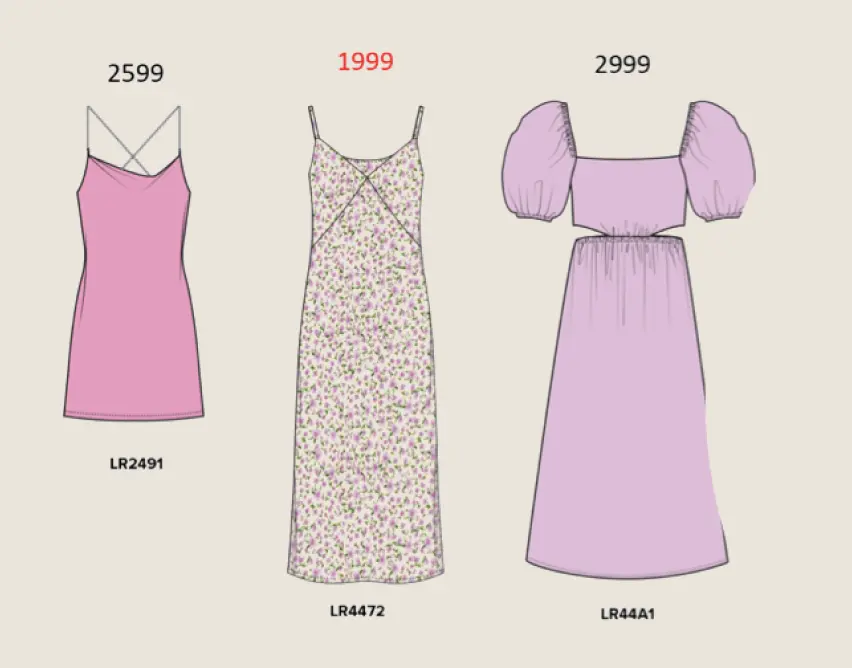
O'Stin pink dress collection — three dresses with prices

The strategic problem

The brief's stated goals sat at a different level than its mechanic. The objectives were perception ones — lift brand-health, earn the attention of young stylish ladies for the brand itself, not just the offer. But a discount-led execution does the opposite: it trains an audience to look at the price, not the brand.

So the real question wasn't how do we sell the dresses. It was: how does a mass-market brand earn the attention of an audience that takes its cues from fashion and instinctively scrolls past discount advertising?

From the deck Audience — young stylish ladies

The campaign targets the attention of young stylish ladies to O'STIN

They want to be in trend and buy clothes from fashionable brands
The right outfit lifts their mood and gives them confidence
It matters to look in a way that draws admiration — and that they like themselves
They like to change to stay relevant and on point in any situation
They seek inspiration from fashion bloggers: how to mix accessories, colours and trends
Approach

Give a mass-market retailer the right to be read as fashion.

01

The audit

A full category, key-trends and competitor audit across the apparel sector — positioning, communication, design and tone of voice — mapping the codes the category used to address young stylish ladies, and finding where O'Stin could occupy a space the competition wasn't.

02

The patterns

Two patterns emerged. Competitors used promo, product and brand language interchangeably — flattening any chance of perception shift. And the audience to reach wasn't a price audience but a meaning audience: a group for whom an image works as a manifesto, who choose what they wear to signal something about themselves, not just to look good.

03

The reframe

So the strategic question changed. Not how to advertise a discount on pink dresses, but how to earn a mass-market retailer the right to be read as fashion. The discount was confined to the pack shot where it legally had to live; everything else — imagery, tone, editorial register — was built in the codes the audience actually responded to.

Insight

In the category and in broader culture, pink carries a narrow, outdated code — “for girls, about tenderness.” That code makes bright pink read as risky, “too much,” “not for every occasion.” For a mass-market brand to put it at the centre of a campaign was, on the face of it, the wrong choice.

The cultural history complicates that picture. Pink has carried very different meanings across the last century — and society has consistently re-decided what it means, which is the opposite of a fixed code. For an audience that wants to control the meaning of what they wear, this is not a problem; it is the opening.

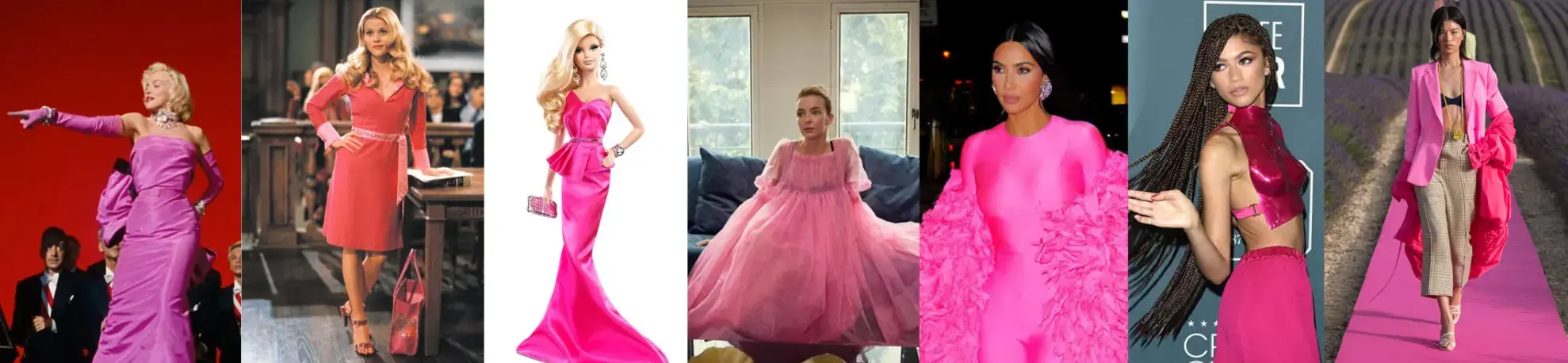
The shifting cultural meaning of pink across the last century
Exhibit — the shifting code of pink Same colour · different meaning
18th C.Wealth & status
20th C.Naivety & femininity
21st C.Strength & political voice
This workMeaning the wearer assigns

The audience isn't asking for pink. They're asking for pink without the stereotype attached to it.

A pink that is noticeable, confident, versatile — and where they themselves decide what it says about them. That single move — from “pink the trend product” to “pink as the meaning the wearer assigns” — is what allowed a discount-led brief to be answered with a campaign about identity.

Solution

The insight resolved into three executable communication directions, each a different answer to the question of what pink lets her say, all built from the same logic. They were handed to the creative team as the brief for development. The campaign that eventually aired carried the underlying insight — “pink without stereotypes, where I decide what it says about me” — forward into production, with the promo confined to the pack shot exactly as the strategy intended.

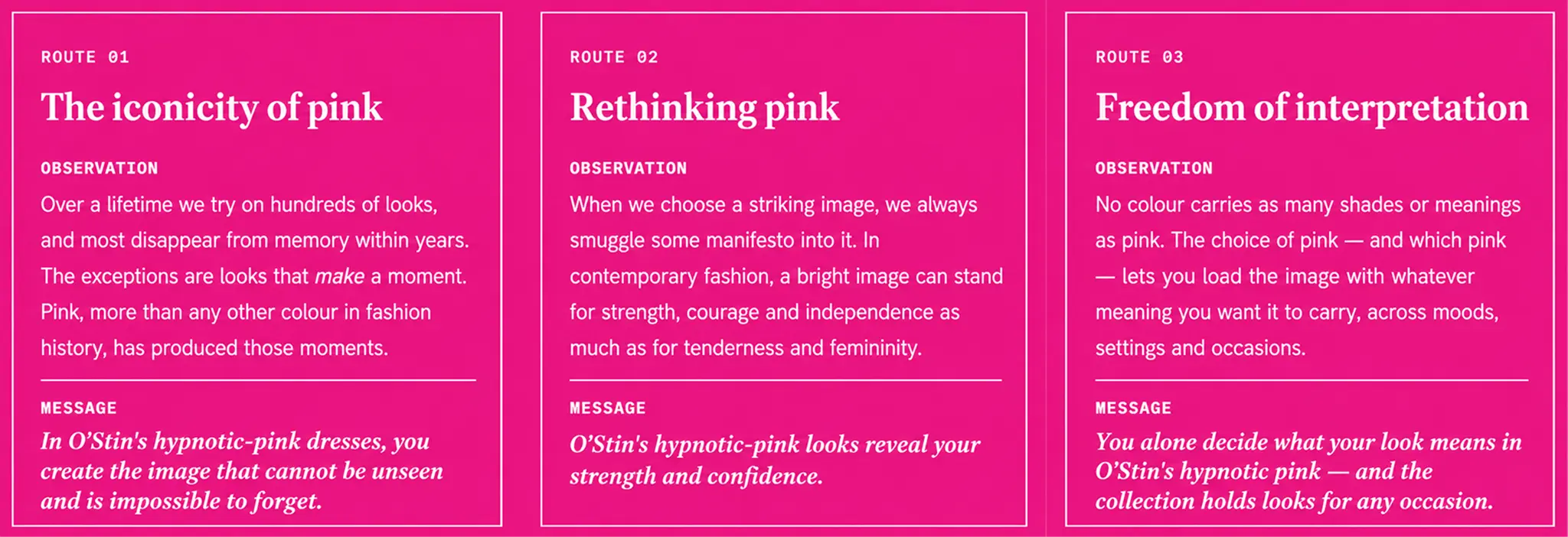
Exhibit Three communication directions on pink
O'Stin — three communication directions on pink (Route 01–03)

Final outcome: what came live

Film 03 10 sec
Outcome

The campaign was produced and ran nationally across TV and digital in 2023. A post-campaign brand-lift study (Ad.Look methodology, Millward Brown — preliminary topline, 20″ film, n=150 women 25–35) measured the work against category norms. The figures below are the study's preliminary topline; the research house flags them as provisional pending the full analytical report.

The strongest indicator was brand linkage — viewers connected the film to O'Stin specifically, not generically to a discount, which is the single most important number for an image-led execution. Branded ad recall and purchase motivation also tracked at or above norm, suggesting the work did not trade commercial pull for image work — it carried both. The research house's own verdict described the result as solid, driven by confident brand linkage.

67Brand linkage — at/above norm
61Branded ad recall — at/above norm
66Purchase motivation (adj.) — at/above norm
62Likeability — at/above norm

Not every metric tracked above norm, and it is worth reading those honestly. Distinctiveness, salience and category-fit scores landed below norm. The honest interpretation is that a single 20-second image film built around a cultural code deliberately does not push “the brand meets your wardrobe needs” — it trades category-claim for perception shift, and that is the exchange the strategy proposed. Re-coding a mass-market retailer's distinctiveness in the eyes of a sceptical audience is a multi-touch, multi-season job. One film opens that work; it does not close it.

23Distinctiveness — below norm
19Salience — below norm
19“Meets category needs” — below norm
21“Sets the tone in the market” — below norm
My role

I owned the analytical foundation for the project: the category and key-trends audit, and the competitor analysis covering positioning, communication, design and tone of voice. From that base I developed the insights and formed the communication directions that went into creative development. The three communication strands were developed under the supervision of the Strategic Director. I created and delivered the strategic part of the client presentation, briefed the creative team, and stayed close to creative through development, assisting in shaping the messages as they took final form.

My role & zone of responsibility

Where I owned the work — and where I worked with the team.

01

Category & key-trends audit Mapped the codes the category used, across the apparel sector.

02

Competitor analysis Positioning, communication, design and tone of voice — to find where O'Stin could stand apart.

03

Insight & communication directions Developed the insights and formed the communication directions that went into creative development.

04

Three communication strands Co-developed under the supervision of the Strategic Director.

05

Client presentation Created and delivered the strategic part of the client presentation.

06

Creative brief & development Briefed the creative team and stayed close through development, helping shape the messages as they took final form.

Next case

TUC — How do you make a “fun” snack brand matter to people too busy to notice the moment?

View case →
Elizaveta Volkova — Brand & Comms Strategist ellivolko@gmail.com  ·  LinkedIn